Engineering Excellence in Modern Aluminium Pivot Door Systems
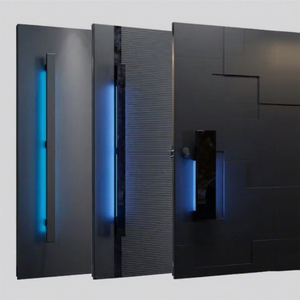
Architectural design has shifted toward grand scale, seamless transitions, and minimalist aesthetics. Among modern fenestration solutions, aluminum pivot doors have emerged as the premier choice for luxury residential entrances, commercial headquarters, and high-end hospitality projects worldwide. Unlike traditional hinged doors that transfer leaf weight to the vertical side jambs, a central axis pivot door transfers its entire static load directly to the floor structural foundation through a specialized top-and-bottom spindle system. This mechanical advantage allows architects and project specifiers to design single-leaf grand entryways reaching heights up to 6 meters and widths exceeding 3 meters without sacrificing structural integrity or smooth operation.
Information Gain Benchmark: How Foshan's Extrusion Technology & Polyamide Thermal Breaks (PA66GF25) Redefined the Structural Performance of Chinese Manufactured Large-Format Doors for North American and Australian Wind Zones.
1. Structural Alloy Metallurgy & Profile Wall Thickness
The foundation of any high-performance pivot door system lies in the metallurgy of the aluminum profile. Premier Chinese manufacturers based in Foshan, Guangdong—the world's capital of architectural aluminum extrusion—utilize prime 6063-T6 or high-strength 6061-T6 structural aluminum alloys. While residential sliding windows often settle for wall thicknesses of 1.4mm to 1.6mm, commercial-grade architectural pivot doors mandate structural extrusions ranging from 2.0mm to 3.5mm minimum wall thickness.
This increased profile mass prevents torsional twisting under heavy wind pressures (DP60 to DP100 ratings) and ensures that heavy double- or triple-glazed insulated units (IGUs) remain perfectly aligned over decades of continuous cycling. Furthermore, advanced surface treatments—including Fluorocarbon (PVDF) coating, AkzoNobel powder coating, and 25-micron anodic oxidation—guarantee resistance against salt-spray corrosion in extreme coastal environments like South Florida, California, and Coastal Australia.
6063-T6 Structural Profile
High-tensile architectural alloy engineered for heavy sash weights, high wind load resistance, and zero structural deflection.
Technoform PA66GF25 Strip
24mm to 34mm reinforced polyamide thermal break barriers reducing U-factors down to 0.28 BTU/hr·ft²·°F for energy star compliance.
Heavy Spindle Hardware
Concealed hydraulic floor closers (FritsJurgens / Dormakaba / Custom Heavy Shafts) certified for 500,000+ open-close cycles.
2. Thermal Performance & Glazing Systems
Historically, pivot doors presented a challenge regarding air infiltration and water tightness due to their non-continuous perimeter frame rebate. Modern engineering from leading Foshan suppliers has eliminated this vulnerability. Advanced pivot doors feature multi-layered perimeter EPDM drop-down acoustic weather seals, concealed magnetic gaskets, and multi-point vertical locking mechanisms.
When combined with warm-edge spacer technology, low-emissivity (Low-E) coatings, argon-gas insulated glass units (IGUs), or hurricane impact-rated laminated glass (PVB/SGP interlayers), modern aluminum pivot doors achieve strict compliance with North American NFRC energy standards and Australian AS2047 fenestration codes.
| Performance Standard | Technical Specification Target | Testing Method / Compliance | Sourcing Grade |
|---|---|---|---|
| Thermal Transmittance (U-Factor) | 0.24 - 0.32 BTU/h·ft²·°F (1.3 - 1.8 W/m²K) | NFRC 100 / ISO 10077-2 | Thermal Break PA66 |
| Structural Wind Load | Design Pressure (DP) 60 to DP100 (Up to 4500 Pa) | ASTM E330 / AS4055 | Heavy-Duty 3.0mm |
| Water Penetration Resistance | 450 Pa - 700 Pa static water pressure | ASTM E547 / AAMA 501.1 | EPDM Cascade Seal |
| Acoustic Attenuation (STC) | STC 38 dB to STC 45 dB reduction | ASTM E90 / ISO 140-3 | Laminated Double IGU |
| Impact Resistance (HVHZ) | Large Missile Impact (Level D, 50 ft/sec) | TAS 201/202/203 / ASTM E1996 | SGP Interlayer 1.52mm |
