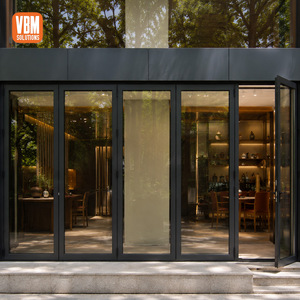
Commercial Aluminum Glass Folding Storefront Door
- Heavy-duty heavy-wall 6063-T5 profile
- Panoramic opening for cafes & retail
- Multi-point compression sealing
Headquartered in Nanhai District, Foshan City—the recognized core hub of global aluminum profile manufacturing—BrioWindow Technology Co., Ltd. stands as a premier manufacturer and international exporter of high-grade commercial entrance systems. With over a decade of dedicated engineering expertise, BrioWindow delivers certified structural entrance doors, storefront assemblies, and automated fenestration solutions to architects, commercial general contractors, and facade importers in over 60 countries worldwide, including key markets in North America, Europe, and Australia.
Engineered for extreme cycle durability, thermal efficiency, structural wind resistance, and modern architectural aesthetics.


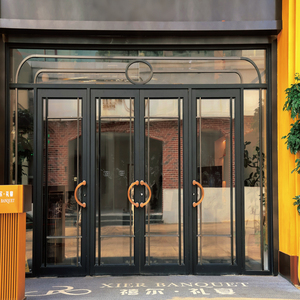
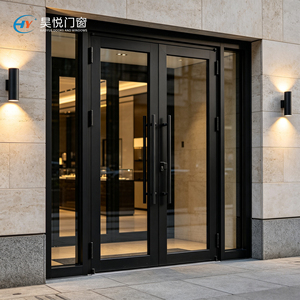
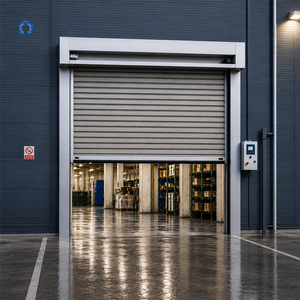


Comparative structural, thermal, and mechanical properties across BrioWindow commercial entrance door series.
| Door System Series | Profile Alloy Grade | Thermal Break (U-Value) | Wind Load (ASTM E330 / AS2047) | Acoustic Rating (STC) | Hardware Integration |
|---|---|---|---|---|---|
| Commercial Storefront Pivot | 6063-T6 / 6060-T66 (2.0mm–3.0mm) | Uf ≤ 1.8 W/m²K (PA66-GF25) | Up to 4500 Pa (Cyclonic Tested) | STC 38 – 42 dB | Dorma / Geze Floor Spring & Custom Handles |
| Bi-Fold Storefront Entrance | 6063-T5 Architectural Grade | Uf ≤ 2.1 W/m²K | 3500 Pa Serviceability Pressure | STC 35 – 39 dB | Stainless Steel Top Track & Bottom Rollers |
| Heavy-Duty Commercial Swing | 6063-T5 Structural Profile | Uf ≤ 1.6 W/m²K (Thermal Strip) | 5000 Pa Ultimate Limit State | STC 40 – 44 dB | Multi-Point Mortise Lock & Panic Hardware |
| High-Speed Industrial Entrance | Extruded Aluminum Slats + Insulation | Thermal Foam Infill Core | 2800 Pa Exterior Rating | STC 30 – 34 dB | Smart Motorized / Radar / Mechatronic Lock |
Rigorous quality control, engineering adaptation to local building codes, and complete supply chain transparency.
Products undergo strict laboratory verification following European CE (EN 14351-1), North American ASTM, and Australian AS2047 window and door standards for structural wind, water, and air infiltration.
Direct integration with Foshan's primary aluminum extruders guarantees 99.7% virgin billet alloy purity (6063/6060 T5/T6), delivering superior tensile strength and surface finish consistency.
From central axis pivot entrance doors to thermal bi-folds, slim-frame sliding assemblies, curtain wall systems, and smart motorized fenestration—consolidate your entire opening schedule under one supplier.
Our in-house engineering team translates complex architectural elevation drawings into precise production shop drawings, complete with glass load calculations and anchoring shop details.
State-of-the-art Fluorocarbon PVDF Kynar 500 spraying,Qualicoat powder coating, and 25-micron anodic oxidation treatments engineered to resist severe coastal salt-spray and ultraviolet fading.
Every commercial door leaves our factory with complete material batch traceability, full inspection sign-offs, and an industry-leading 30-year operational quality assurance guarantee.
The global commercial architecture landscape is undergoing a structural transformation driven by stringent energy efficiency regulations, decarbonization mandates (such as LEED v4.1 and BREEAM standards), and evolving occupant expectations for seamless biophilic design. As the focal point of any commercial facility, the commercial entrance door is no longer merely a physical point of access; it has evolved into a critical thermal barrier, security nexus, and dynamic architectural statement.
Traditional non-thermal aluminium profiles are rapidly being phased out in modern commercial specifications due to high thermal conductivity. The future of commercial entrances lies in multi-cavity thermal profiles equipped with Polyamide PA66-GF25 (25% glass fiber reinforced) thermal barrier strips. When combined with double or triple insulated glass units (IGUs) incorporating argon gas fill, warm-edge spacers, and soft-coat Low-Emissivity (Low-E) coatings, overall system U-values (Uw) can be driven down to below 1.4 W/m²K. Importers should prioritize suppliers capable of co-extruding thermal breaks and offering structural silicone glazing (SSG) for severe climate zones.
Minimalist architectural trends demand maximum glass area with visually imperceptible frame profiles. However, commercial entrance doors face significant wind load pressures and high-frequency opening cycles. Innovation in 6060-T66 high-tensile alloy formulations allows BrioWindow engineers to minimize face widths to as narrow as 20mm while maintaining structural moment of inertia (Ix/Iy). This structural optimization prevents frame deflection even under extreme wind pressure tests exceeding 4000 Pascals.
Post-pandemic building specs heavily emphasize touchless access and automated building management system (BMS) connectivity. Modern commercial aluminium entrance doors increasingly integrate concealed motor actuators, motorized multi-point locks, biometrics, facial recognition, and radar sensors. BrioWindow’s smart commercial door series incorporates internal wire routing channels and standardized electrical conduit paths within the extruded profile chambers to allow plug-and-play installation for global security integrators.
Enterprise real estate developers in North America, Europe, and Australia are requiring Environmental Product Declarations (EPDs). Sourcing aluminium entrance doors produced using renewable hydropower electricity during billet smelting significantly reduces embedded carbon footprints. BrioWindow’s supply chain emphasizes recycled aluminum scrap integration (up to 75% recycled content) without compromising metallographic grain structure or structural shear strength.
Importing commercial aluminium entrance doors from China requires a structured quality assurance framework to prevent costly jobsite delays and ensure full compliance with destination building codes. Below is the step-by-step audit framework recommended by BrioWindow’s senior SEO and supply chain growth directors:
Before issuing purchase orders, request factory engineering software simulations (such as LBNL THERM and WINDOW analysis) verifying that the proposed profile dimensions and glass combinations satisfy local thermal performance (U-factor, SHGC) and wind load requirements (ASW / ASTM E330).
Ensure the manufacturer utilizes primary aluminum billets conforming to GB/T 5237 / ASTM B221 specs. On-site ultrasonic wall thickness checks should confirm that structural profile wall thicknesses satisfy minimum commercial requirements (typically ≥2.0mm for commercial entrance doors and storefronts).
High-traffic commercial entrances require hardware rated for at least 500,000 to 1,000,000 opening cycles. Verify that heavy-duty floor springs, top pivots, panic bars, and continuous hinges are sourced from verified brands (such as Dorma, Geze, Allegion, or BrioWindow’s proprietary heavy-duty commercial hardware line).
Commercial entrance doors feature large-format glass panels vulnerable to dynamic racking stresses during container transport. BrioWindow utilizes customized IPPC-certified fumigated solid wooden crates, corner rubber guards, protective polyolefin film, and desiccant bags to eliminate moisture condensation and corrosion during transit.
Direct technical answers for commercial project buyers, architectural specifiers, and facade importers.
Our commercial entrance systems are engineered and tested to satisfy major international building standards. We provide compliance test reports for Australian Standard AS2047 / AS1288, European CE marking (EN 14351-1), and North American ASTM standards for structural wind pressure, water penetration, and air infiltration.
Yes. 100% of our production is customized to specific project opening schedules. Our engineering department reviews architectural CAD or PDF drawings, confirms structural wind load calculations, and generates detailed shop drawings for client sign-off prior to extrusion cutting.
For coastal applications exposed to high salt spray and UV radiation, we recommend Fluorocarbon PVDF Kynar 500 coating (available in 2-coat, 3-coat, or 4-coat systems) or Class 1 / Class 2 Anodized finishes (minimum 20–25 microns). These finishes exceed AAMA 2605 specifications and prevent oxidation and chalking.
Standard lead time for custom production is 25 to 35 business days following shop drawing confirmation and deposit receipt. For projects requiring specialized custom extrusion dies or unique glass configurations (such as bullet-resistant or electrochromic glass), lead time is typically 35 to 45 days.
We generally specify double-tempered or laminated insulated glass units (e.g., 6mm Low-E Tempered + 12mm Argon Space + 6mm Clear Tempered, or 6mm + 1.52PVB + 6mm Laminated Safety Glass). Laminated glass provides enhanced forced-entry protection and high acoustic STC ratings for high-traffic city locations.
We provide full installation technical documentation, 3D exploded assembly diagrams, and step-by-step video tutorials. For large commercial contract developments, our technical engineers are available for remote video consultation or on-site installation guidance.
Contact our engineering sales department today to request full technical catalogs, structural test reports, profile samples, or a competitive factory-direct quotation for your project schedule.
Get Catalog