China’s aluminum door sector sits within a vast materials and construction supply chain. The National Bureau of Statistics of China reported 41.59 million tonnes of primary aluminum production in 2023. That figure signals industrial scale, but it does not measure door quality or factory capacity. Buyers still need to verify what each manufacturer actually produces.
The International Aluminium Institute identifies building and construction as a major end-use sector for aluminum. For buyers, the appeal is practical: aluminum frames can support slim sightlines, large glazed panels, and durable finishes. Yet performance depends on more than the frame. Thermal breaks, hardware, seals, coating quality, and installation details all matter. Small differences show up at the threshold, where a poorly fitted door may admit water or feel stiff.
This guide examines leading Aluminum Door manufacturers in China through product range, production capability, quality evidence, and export experience. It also considers what published specifications can—and cannot—prove. A polished catalogue is not a factory audit. Ask for test reports, sample details, and clear warranty terms. Then compare them against the project’s climate, opening size, and usage. Some evidence may be incomplete. That deserves scrutiny, not an assumption of poor performance.
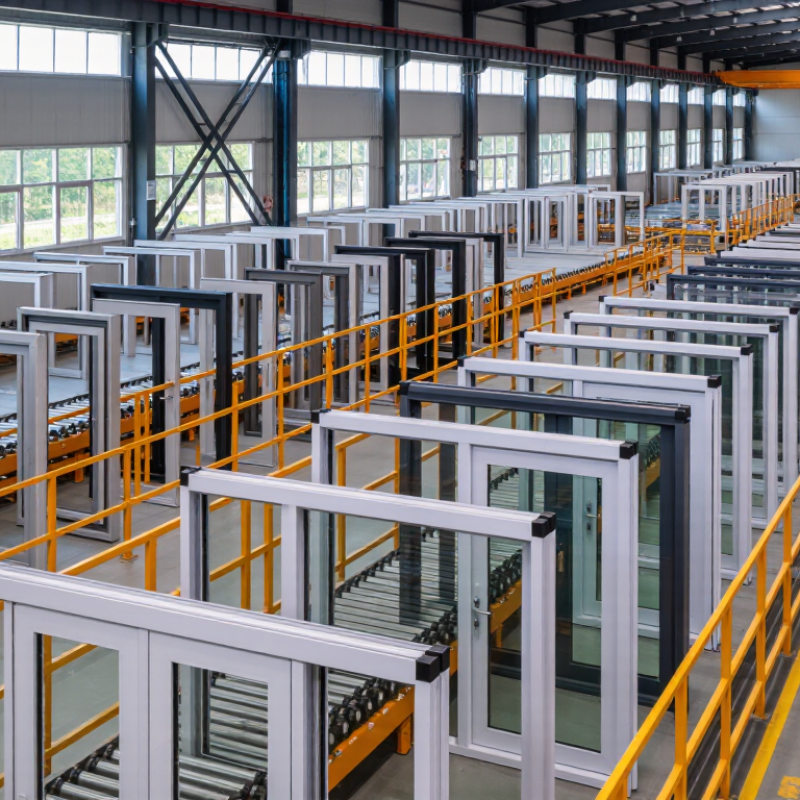
In China, an aluminum door manufacturer is more than a workshop assembling frames. A credible producer controls alloy sourcing, profile extrusion, surface treatment, glass selection, hardware fitting, and final inspection. Its engineers understand wind pressure, drainage, thermal movement, and local building conditions. They should provide clear profile drawings, performance data, and material specifications. Guesswork is a warning sign. Details matter.
Practical experience appears on the factory floor. Staff check profile thickness with calipers, inspect corner joints, and test hinges through repeated cycles. Quality teams should record batch numbers, coating results, and glass tolerances. Reliable manufacturers also build sample doors before mass production. This exposes alignment problems early. It sounds simple, but many projects fail here. A serious supplier can explain how thermal bridges, poor drainage, or weak fasteners affect service life. Certifications help, yet they should support real testing rather than replace it.
Professionalism also shows in communication. The manufacturer should confirm opening sizes, handing direction, color references, packaging, shipping terms, and installation responsibility in writing. Site photos and measured drawings reduce costly assumptions. After delivery, responsive technical support matters when walls are uneven or hardware needs adjustment. No factory is flawless. An honest team admits limits and proposes workable changes. That is more dependable than promising every design at the lowest price.
China’s aluminum door industry is organized as a connected supply chain, not a single-factory model. Extruders turn aluminum billet into profiles, which are cut and assembled into door frames. Glass processors, hardware suppliers, and coating facilities provide components or services along the way. Some manufacturers buy finished profiles; others manage several production stages in-house. That division is useful, but not always tidy.
Regional manufacturing clusters often place extrusion, coating, glass processing, and assembly within practical shipping distance. This can shorten lead times and make custom sizes easier to coordinate. Factories may focus on sliding doors, thermal-break systems, or project-specific entrance units. Larger orders can pass through fabricators, installers, and distributors before reaching a building site. There are exceptions.
For buyers, an important distinction is whether a supplier makes profiles or complete doors. Ask who controls cutting, corner crimping, glazing, sealing, and final inspection. A sample corner joint, coating record, and water-test report can offer more insight than a polished catalogue. Supplier roles may overlap, and stated capacity may not reflect a busy production season. Verify the actual manufacturing route when dimensions or glass specifications change.
Annual primary aluminum production in China, 2020–2024 (million metric tonnes)
Aluminum door manufacturing is a downstream industry: producers generally source aluminum profiles and combine fabrication with glazing, hardware, finishing, and distribution. This chart shows upstream primary aluminum output—not door production or manufacturers’ market share. Source: National Bureau of Statistics of China.
Choosing a leading Chinese aluminum door manufacturer requires more than comparing catalog prices. Look for a documented production history, stable staffing, and clear responsibility for design, fabrication, and inspection. A credible supplier should explain alloy grades, profile thickness, thermal breaks, hardware options, and surface finishes in plain language. Ask for recent project references and samples that match the proposed specification.
Technical capability is visible in details. Check whether drawings show dimensions, opening direction, drainage paths, and installation tolerances. Request test reports for air leakage, water resistance, wind pressure, and thermal performance when relevant. Confirm that each report identifies the tested configuration; results for one door design may not apply to another. Numbers matter.
Assess quality control through inspection records, traceability, packaging checks, and a documented process for handling defects. Compare lead-time claims with recent, similar orders rather than an ideal schedule. Ask who handles technical questions after shipment and how replacement parts are arranged. Factory visits can help, though a polished showroom does not prove consistent output. No checklist is perfect; approved samples and clear specifications reduce guesswork, but cannot remove every production risk.
China’s aluminum door manufacturers draw strength from a deep materials supply chain. The International Aluminium Institute reported roughly 70.6 million tonnes of global primary aluminum production in 2023, with China producing about 41.5 million tonnes. That scale can support steady access to profiles, hardware, and finishing services. It does not guarantee a better door. Strong manufacturers distinguish themselves through controlled extrusion, accurate corner joints, durable coatings, and thermal-break designs suited to local climates. Details matter. Some factories also offer made-to-measure frames for narrow balconies or irregular renovation openings, where installation accuracy is critical.
Manufacturing capability varies. A supplier with in-house testing can document air leakage, water resistance, and wind-load performance, rather than relying only on product claims. Ask for current test reports and check that their sample matches the quoted design. Export experience may help with packaging and dimensional consistency, but it is not a substitute for clear specifications. Not every factory excels. Buyers should compare frame depth, glass compatibility, drainage design, and warranty terms, since low prices can hide thinner profiles or limited after-sales support.
Tips: Request a cutaway sample and inspect the thermal break, seals, and drainage channels. Confirm lead time, packaging, and replacement-part availability in writing. A polished showroom sample may not represent every production batch.
Compare aluminum door manufacturers by matching evidence to site conditions, not by brochure claims. Ask for profile drawings, alloy and temper data, coating specifications, and test reports for the exact door system. Details matter. A coastal project may need stronger corrosion protection than an inland office. Check whether quoted thermal and air-leakage values apply to the proposed glass, frame size, and hardware. If test records cover a different configuration, request clarification in writing.
Compare fabrication capacity, quality checks, and delivery assumptions. Ask how the factory controls corner joints, drainage paths, and dimensional tolerances; request photos or inspection records from recent production. A sample corner cutaway can reveal more than a polished showroom unit. Confirm who measures openings, handles installation questions, and manages replacement parts.
Then review lead time, packaging, shipping terms, and warranty exclusions against your project schedule. A low price can hide omitted screens, hardware, or site support. Keep a simple comparison sheet, but do not treat every item as equally important. No scorecard is perfect. Weight performance and service according to climate, building use, and installer skill. Some details may remain uncertain until a full-size mock-up is tested; record that risk instead of assuming it away.
It works as a supply chain. Extruders make profiles, while other facilities process glass, coatings, hardware, and assembly.
No. Some buy finished profiles; others manage several production stages in-house. Not always neatly.
Ask who handles cutting, corner crimping, glazing, sealing, and final inspection. Confirm the actual manufacturing route.
Inspect a sample corner joint, coating records, and water-test reports. A polished catalogue proves little.
Check dimensions, opening direction, drainage paths, and installation tolerances. Small omissions can complicate fitting.
Confirm each report matches the proposed door configuration. Results from one design may not apply to another.
Review inspection records, traceability, packaging checks, and defect handling. Compare lead times with recent, similar orders.
Ask who answers technical questions after shipment and how replacement parts are arranged. Even careful checks miss things.
China’s aluminum door industry includes manufacturers with different production scales, technical capabilities, and areas of specialization. Some focus on standard residential doors, while others offer customized systems for commercial buildings or projects requiring specific dimensions, finishes, and performance features. A leading Aluminum Door manufacturer is generally distinguished by consistent product quality, dependable production capacity, skilled design support, and clear communication throughout the ordering process.
When comparing manufacturers, buyers should consider material specifications, fabrication methods, available customization, quality-control procedures, lead times, and after-sales support. It is also useful to assess whether a supplier can provide suitable documentation, samples, and practical guidance for installation and maintenance. The best choice depends on the project’s budget, design requirements, delivery schedule, and intended use. Evaluating these factors side by side can help buyers identify a capable Chinese manufacturer and select doors that meet their functional and aesthetic needs.