Choosing an Aluminum Bathroom Door is a small decision with surprisingly large consequences. It affects privacy, ventilation, cleaning, safety, and the room’s visual balance. A door that looks elegant in a showroom may feel noisy, stiff, or difficult to clean after six months. That detail matters.
Industry research supports a careful approach. Houzz’s 2024 U.S. Bathroom Trends Study highlights continued investment in bathroom upgrades, including improved functionality and durable finishes. The National Kitchen & Bath Association’s 2024 Bathroom Design Trends Report also emphasizes wellness, accessibility, and long-term usability. These findings suggest that appearance alone should not guide your purchase. A reliable door must suit daily routines, moisture exposure, available space, and future household needs. It should open smoothly beside a wet towel, resist corrosion near the shower, and remain stable when humidity rises.
Material performance deserves equal attention. The Aluminum Association identifies aluminum’s light weight, corrosion resistance, and recyclability as important advantages in building applications. However, aluminum is not automatically high quality. Poorly finished frames can discolor, flex, or develop rough edges. That assumption can fail. Check the alloy, surface treatment, hardware grade, seal design, and installation method before comparing prices. The following seven tips turn those checks into practical decisions. They also leave room for honest reflection: the cheapest door may be affordable today, yet expensive to repair later. A measured choice usually begins with the room itself, not the product photograph.
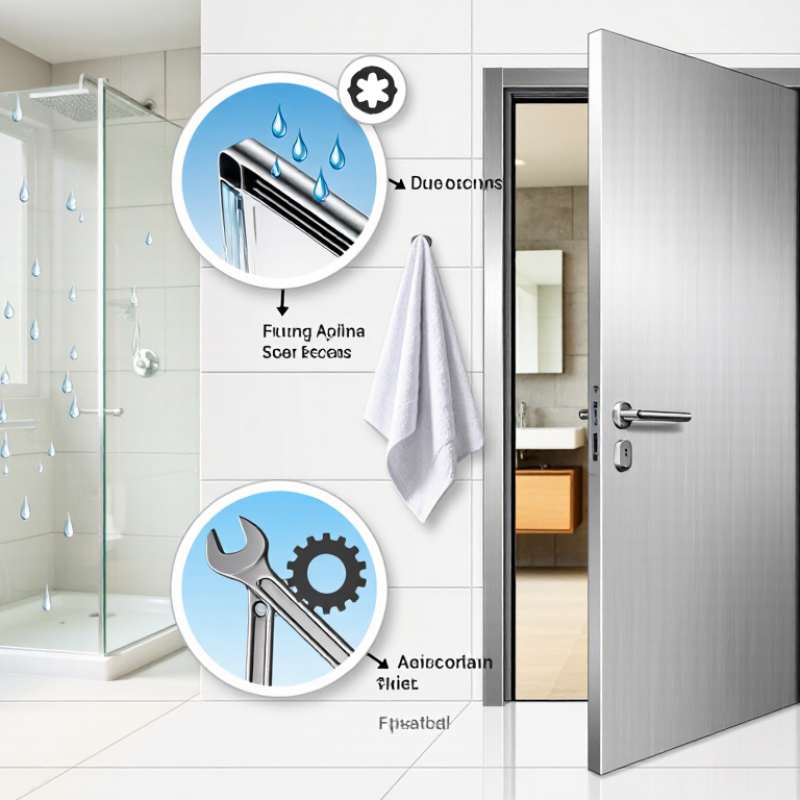
7 Tips for Choosing an Aluminum Bathroom Door
Understanding the aluminum alloy matters more than choosing a shiny appearance. A 6063-grade alloy is commonly used for frames because it is lightweight, corrosion-resistant, and easy to shape. Check the frame thickness as well. Very thin sections may flex around the hinges and create gaps after repeated use. A sturdy frame should feel rigid, not hollow and weak.
The finish protects the metal from humid air, soap, and cleaning products. Powder coating creates an even colored layer with a soft, consistent texture. Anodizing forms a harder surface and often shows the natural aluminum tone. In a small bathroom, satin finishes can hide water marks better than high-gloss surfaces. Dark colors look modern, but they may reveal dust and mineral spots quickly. I once underestimated this detail.
Inspect the corners and cut edges carefully. Poorly sealed joints can allow moisture to reach the inner frame, even when the outer finish looks perfect. Ask whether the coating has been tested for adhesion, humidity exposure, and household cleaners. Hardware also matters. Stainless steel hinges and quality seals usually handle daily moisture better than weak plated parts. Leave enough clearance beneath the door for airflow, but avoid a large gap that reduces privacy. A magnetic seal can close quietly, although it may need adjustment when the frame settles. Specifications help, but a simple touch test still reveals surprising flaws.
Choosing an aluminum bathroom door begins with accurate doorway measurements. Measure the width at the top, middle, and bottom. Record the smallest number, not the most convenient one. Walls can taper slightly. Measure the height on both sides. Use the shorter height when ordering. A few millimeters matter.
Measure from the finished tile surface, not from the bare wall. Include trim, sealant, and any uneven edges in your inspection. Check the opening depth with a steel tape. Then test whether the floor is level and the side walls are plumb. A simple spirit level helps reveal hidden slopes. Small errors grow quickly.
I once measured only the center of an opening and regretted it. The lower corner was narrower by several millimeters.
Measure twice. Write every result down, including units. Confirm whether the listed door size means the panel size or the required opening size. This detail is easy to misunderstand.
Leave suitable clearance for hinges, seals, and door movement. Mark the intended swing before installation, especially near a toilet, vanity, or shower screen.
If the opening is badly uneven, pause and ask a qualified installer to assess it. Guessing feels faster, but replacement work costs more time.
Aluminum Bathroom Doors: Comparing Moisture Resistance and Structural Durability
In bathroom projects, I check moisture exposure before judging appearance. Steam settles on frames, hinges, and lower corners. Aluminum resists swelling and rust better than many common door materials. However, untreated surfaces can still stain, pit, or weaken near salts and cleaning chemicals. Look for a tested protective coating, sealed joints, and drainage paths at the sill. These small details often matter more than a bright finish.
Check the frame thickness, hinge attachment, and corner construction. A rigid frame should close without twisting when lightly pushed. Examine the door’s weight, opening direction, and wall support. Heavy panels need dependable hinges and properly reinforced fixing points. Ask for test information on humidity, corrosion, and repeated opening cycles. Standards vary, so vague claims deserve questions. Keep seals flexible and replace them when they crack. Wipe standing water from the bottom edge. Ventilation helps, too. I once assumed a thicker panel guaranteed strength; it did not. Poor installation caused movement within months. That mistake changed my checklist: compare material, hardware, installation quality, and maintenance together. A door can resist moisture yet fail structurally if its anchors loosen. Conversely, a strong frame may age badly when water remains trapped inside. Check both conditions before choosing.
| Tip | Evaluation Dimension | Relevant Data or Specification | Why It Matters in a Bathroom | Practical Selection Guidance |
|---|---|---|---|---|
| 1 | Choose a suitable aluminum alloy and temper | Common architectural 6063-T5 aluminum has a typical minimum tensile strength of about 150 MPa and yield strength of about 110 MPa, although exact values vary by product standard and section size. | A properly selected alloy provides adequate rigidity for door frames while remaining naturally resistant to rot and moisture absorption. | Ask for the alloy and temper designation rather than accepting the general term “aluminum.” For large or heavy doors, prioritize a reinforced profile and a design-specific structural calculation. |
| 2 | Compare moisture resistance with other door materials | Aluminum does not swell, warp, or biologically decay when exposed to ordinary bathroom humidity. Wood-based doors can absorb moisture, while steel may corrode if its protective coating is damaged. | Frequent steam, splashing, and wet cleaning can cause dimensional changes in moisture-sensitive materials, affecting alignment and latch operation. | Use aluminum for wet zones, but do not overlook seals, joints, fasteners, and the wall connection; these components can still allow water ingress. |
| 3 | Check the surface protection system | Typical anodized aluminum finishes are commonly specified in the approximate 10–25 μm coating range. Architectural powder coatings are often applied at approximately 60–120 μm, subject to the coating system and specification. | The protective finish helps reduce staining, oxidation, and corrosion caused by humidity, cleaning chemicals, and airborne salts. | Prefer a continuous, uniform finish with protected cut edges. Avoid abrasive cleaners and inspect scratches promptly, especially in coastal or highly chlorinated environments. |
| 4 | Evaluate frame geometry and reinforcement | Door stiffness depends on profile depth, wall thickness, corner joints, mullions, hinge spacing, and the door’s width and height—not on aluminum grade alone. | An under-reinforced frame may deflect, causing uneven gaps, rubbing, loose hinges, or poor latch engagement. | For tall, wide, sliding, or heavy glazed doors, select deeper profiles, reinforced hinge zones, mechanically secured corners, and a design with adjustable alignment. |
| 5 | Inspect hinges, fasteners, and hardware materials | Austenitic stainless steels such as 304 and 316 are widely used for wet-area hardware. Grade 316 generally offers better resistance to chlorides than grade 304 because of its molybdenum content. | Hardware often fails before the aluminum frame because hinges, screws, and latch components experience repeated wetting and mechanical loading. | Use corrosion-resistant hardware, isolate incompatible metals where necessary, and confirm that hinge capacity exceeds the fully assembled door weight with a safety margin. |
| 6 | Verify seals, drainage, and installation details | EPDM seals are commonly used for doors because they retain flexibility over a broad temperature range and resist water, ozone, and weathering better than many general-purpose rubbers. | A moisture-resistant frame cannot prevent leaks if the threshold, perimeter gasket, screw penetrations, or drainage path is poorly designed. | Look for continuous gaskets, sloped or drained thresholds where appropriate, sealed fastener penetrations, and installation instructions for wet-room conditions. |
| 7 | Request performance testing and maintenance information | Relevant test methods may include ASTM E283 for air leakage, ASTM E331 for water penetration under static pressure, and ASTM E330 for structural performance; the required rating depends on the project. | Test evidence provides more reliable information than appearance alone, particularly for doors exposed to direct spray or high humidity. | Request reports for the complete door assembly, clean surfaces with mild detergent and water, rinse thoroughly, and inspect seals, drainage openings, fasteners, and finish damage periodically. |
Note: Material strengths, coating thicknesses, and performance ratings are representative industry values or commonly used specifications. Actual results depend on alloy temper, profile design, finish system, hardware, installation quality, exposure conditions, and the applicable local standard.
7 Tips for Choosing an Aluminum Bathroom Door
Selecting the Right Style, Hardware, and Privacy Features
A bathroom door should suit the room’s layout, moisture level, and daily routine. A slim aluminum frame works well in compact spaces and keeps the visual line clean. Choose a sliding style when a door swing would block a vanity or towel rail. For wider bathrooms, an outward-opening door may improve movement during emergencies. Measure twice. Small errors can create uneven gaps and difficult installation.
Select a finish that matches the room, but inspect samples under both daylight and warm lighting. Brushed surfaces often hide fingerprints better than glossy finishes. Hardware needs equal attention. Stainless steel hinges, a firm lever handle, and a quiet magnetic latch can improve everyday use. Check that the hinges support the door’s weight without sagging. Details matter. I once underestimated handle clearance, and the door struck a nearby cabinet whenever it opened.
Privacy choices should reflect who uses the bathroom. Frosted or textured glass allows daylight while limiting clear views. Fully opaque panels provide stronger privacy, but they can make a small room feel darker. A lock should show occupancy clearly and release from outside during an emergency, when appropriate. Ventilation also matters; a small undercut or suitable vent can reduce condensation. Privacy is personal. Consider sound, visibility, and cleaning effort together rather than choosing appearance alone. Loose hardware should be checked after installation and periodically retightened.
Choosing an aluminum bathroom door requires more than comparing finishes. Begin by checking the opening size, wall condition, swing clearance, and threshold level. Accurate measurements prevent uneven gaps and costly rework. A professional installer should also confirm that fasteners suit the wall material. Small errors become obvious in a humid room.
Consider seven practical points: corrosion-resistant aluminum, sealed corners, smooth hinges, adjustable hardware, tempered glass compatibility, easy-clean surfaces, and warranty terms. Aluminum is light and generally resists bathroom moisture, but poor coatings can discolor or pit. The U.S. Department of Energy reports that heat gain and loss through windows represents about 25–30% of residential heating and cooling energy use. This is not a bathroom-door statistic, but it reinforces the value of tight seals and controlled air movement.
Maintenance should be simple. Wipe mineral deposits weekly, dry the lower frame, and inspect silicone joints every few months. Do not assume “low maintenance” means maintenance-free. The U.S. Environmental Protection Agency’s WaterSense program estimates household leaks waste nearly 10,000 gallons of water annually, showing how small failures can accumulate. A loose seal may not waste that much, yet it can damage flooring and encourage mold. I once overlooked a slightly sloped threshold; water reached the frame repeatedly. The door still looked attractive, but its installation was flawed. Compare purchase price, installation labor, cleaning time, replacement hardware, and expected service life before judging overall value.
Measure the top, middle, and bottom. Use the smallest measurement. Walls can taper slightly. Measure from finished tile, not bare wall. Record every unit.
Measure both sides. Use the shorter height when ordering. Include trim, sealant, and uneven edges. A few millimeters matter.
Confirm whether the listed size means panel size or opening size. Leave clearance for hinges, seals, and door movement. Do not guess.
Check the floor with a spirit level. Check whether the side walls are plumb. If the opening is badly uneven, pause and ask a qualified installer. I once measured only the center.
A sliding door saves swing space. It can prevent contact with a vanity or towel rail. Mark the movement path before installation. Compact layouts need careful planning.
Choose hinges that support the door’s weight. Check handle clearance near cabinets. A firm lever and quiet magnetic latch improve daily use. Small details matter.
Frosted or textured glass limits clear views while allowing daylight. Opaque panels provide stronger privacy but may darken the room. Consider sound, visibility, and cleaning.
Wipe mineral deposits weekly. Dry the lower frame. Inspect silicone joints every few months. Check loose hardware periodically. Low maintenance is not maintenance-free.
Confirm fasteners suit the wall material. Check the threshold, seals, and corner joints. A loose seal can damage flooring and encourage mold. Attractive installation is not always sound.
Compare purchase price, installation labor, cleaning time, replacement hardware, and service life. Aluminum generally resists bathroom moisture. Poor coatings can discolor or pit. My earlier choice looked good, but the sloped threshold caused trouble.
Choosing the right Aluminum Bathroom Door requires more than selecting an attractive design. Start by understanding the material and finish, since different coatings can affect appearance, corrosion resistance, and long-term performance in a humid environment. Measure the doorway carefully, including its height, width, and wall thickness, to ensure a proper fit and avoid installation problems. It is also important to compare moisture resistance, frame strength, and hardware quality so the door can withstand frequent use without warping or weakening.
Next, consider the bathroom’s style, available space, and privacy needs. Options such as clear, frosted, or textured panels can provide different levels of light and seclusion, while suitable handles, hinges, and locks improve convenience. Finally, evaluate whether professional installation is needed, how easy the surface is to clean, and what maintenance may be required. A well-chosen Aluminum Bathroom Door should balance durability, appearance, privacy, installation requirements, and overall value.